• (216) 767-6323
  • office@juststumpit.com
  • OHIO

Cleveland’s Nature, Our Everyday Life.

Interesting facts about nature and life in Cleveland, Ohio.

🐦 Cleveland sits on a major migratory bird highway. More than 300 species pass through the Lake Erie corridor each year.
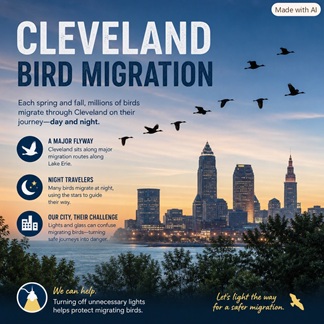
An interesting nature fact from Cleveland. 🐦 Cleveland sits on a major migratory bird highway. More than 300 species pass through the Lake Erie corridor each year. Even tiny backyard trees and shrubs become rest stops for warblers, finches, and hummingbirds. "Lights Out Cleveland" is a volunteer-driven bird migration monitoring program that protects nocturnally migrating birds in downtown Cleveland. Volunteers walk early morning routes during spring and fall migration to find injured or deceased birds, collect them safely, and record precise data on collision locations. Injured birds are transported to the Lake Erie Nature & Science Center for rehabilitation, while data from all findings helps map collision “hotspots” and guide building light reduction efforts across the city. The program began in 2016 and now operates daily during migration seasons, with volunteers typically starting around 5:30–6:00 a.m. The program operates daily from March 15 to June 15 and from August 15 to November 15.

Even tiny backyard trees and shrubs become rest stops for warblers, finches, and hummingbirds. "Lights Out Cleveland" is a volunteer-driven bird migration monitoring program that protects nocturnally migrating birds in downtown Cleveland. Volunteers walk early morning routes during spring and fall migration to find injured or deceased birds, collect them safely, and record precise data on collision locations. Injured birds are transported to the Lake Erie Nature & Science Center for rehabilitation, while data from all findings helps map collision “hotspots” and guide building light reduction efforts across the city. The program began in 2016 and now operates daily during migration seasons, with volunteers typically starting around 5:30–6:00 a.m. The program operates daily from March 15 to June 15 and from August 15 to November 15.

An interesting nature fact from Cleveland. 🍁 Northeast Ohio has one of the highest tree canopy densities in the Midwest. Cleveland’s canopy averages 33–35%, with pockets in Rocky River, Westlake, and Gates Mills hitting over 50%. Great for shade — tricky for lawns. 🌲 The Forests of Northwest Ohio. Northwest Ohio’s forests are quiet survivors of glacial history — shaped by ancient lakes and rich, wet soils. From oak hickory uplands to swampy lowlands filled with silver maple and cottonwood, these woods form a patchwork of life that filters water, shelters wildlife, and steadies the wind off Lake Erie. Each stump, root, and fallen log tells the story of how the land renews itself — one season, one sprout at a time.
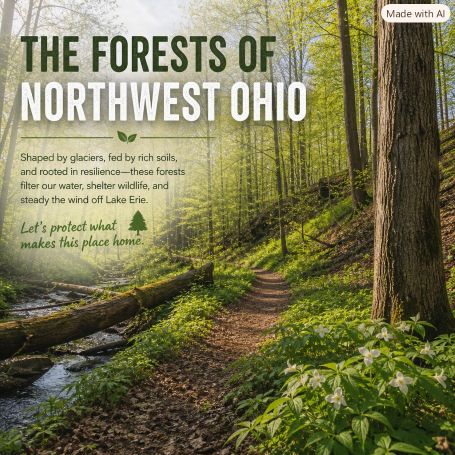
🌲 The Forests of Northwest Ohio.

Northwest Ohio’s forests are quiet survivors of glacial history — shaped by ancient lakes and rich, wet soils. From oak hickory uplands to swampy lowlands filled with silver maple and cottonwood, these woods form a patchwork of life that filters water, shelters wildlife, and steadies the wind off Lake Erie. Each stump, root, and fallen log tells the story of how the land renews itself — one season, one sprout at a time.

Monarch butterflies pass right through Cleveland on their 3,000‑mile migration, using our Lake Erie shoreline as a major navigation landmark before heading south toward Mexico. The coolest thing about monarchs is that one generation basically breaks the rules of butterfly biology. The “super generation” (also called the Methuselah generation) lives 6–8 months, while the other monarch generations live only 2–6 weeks. This long‑lived group is the one that makes the full migration from the northern U.S./Canada all the way to central Mexico — a journey up to 3,000 miles. A quick breakdown of why they’re special: They delay reproduction. Unlike summer monarchs, they don’t mate right away. Their bodies shift into a migratory, long‑distance mode. They store more fat. This fuels the entire migration and helps them survive winter in Mexico. They’re built for endurance. Their wings are slightly different — often larger and more aerodynamic. They restart the cycle. In spring, they finally reproduce and begin the northward migration, creating the next generations that spread across the continent. It’s one of the most dramatic life‑cycle pivots in the insect world — a tiny creature switching from “live fast, die young” to “endurance athlete” depending on the season. Whether the monarch’s long‑lived generation points to evolutionary adaptation or something that appears intentionally shaped is ultimately up to each observer. The phenomenon stands on its own — remarkable, precise, and undeniably fascinating — inviting people to draw their own meaning from it without being pushed toward any single explanation. And yet... give it some thought and share your opinion in the comments.

The coolest thing about monarchs is that one generation basically breaks the rules of butterfly biology.

The “super generation” (also called the Methuselah generation) lives 6–8 months, while the other monarch generations live only 2–6 weeks. This long‑lived group is the one that makes the full migration from the northern U.S./Canada all the way to central Mexico — a journey up to 3,000 miles.
A quick breakdown of why they’re special:
They delay reproduction. Unlike summer monarchs, they don’t mate right away. Their bodies shift into a migratory, long‑distance mode.
They store more fat. This fuels the entire migration and helps them survive winter in Mexico.
They’re built for endurance. Their wings are slightly different — often larger and more aerodynamic.
They restart the cycle. In spring, they finally reproduce and begin the northward migration, creating the next generations that spread across the continent.
It’s one of the most dramatic life‑cycle pivots in the insect world — a tiny creature switching from “live fast, die young” to “endurance athlete” depending on the season.
Whether the monarch’s long‑lived generation points to evolutionary adaptation or something that appears intentionally shaped is ultimately up to each observer. The phenomenon stands on its own — remarkable, precise, and undeniably fascinating — inviting people to draw their own meaning from it without being pushed toward any single explanation. And yet... give it some thought and share your opinion in the comments.

0 0 votes
Article Rating
Subscribe
Notify of
guest

0 Comments
Oldest
Newest Most Voted
Translate »
0
Would love your thoughts, please comment.x
()
x