• (216) 767-6323
  • office@juststumpit.com
  • OHIO

The Chestnut Moth Invasion: Why America Must Stay Alert.

Across Europe, one tiny insect has transformed entire city landscapes, weakened iconic trees, and forced municipalities into costly annual treatments. That insect is the European chestnut moth (Cameraria ohridella) — a leaf mining pest that aggressively attacks horse chestnut trees and spreads with explosive speed.

While not currently found in the United States, this pest poses a serious threat if ever introduced. Its biology, behavior, and damage patterns make it far more destructive than the harmless native species Americans are used to seeing.
This article explains why the European chestnut moth is dangerous, how it differs from the native American chestnut moth, and what signs would raise red flags for early detection.

What Makes the European Chestnut Moth Dangerous?

Sudden, severe leaf drop.

Cameraria ohridella can produce three to four generations per year, each one mining the leaves until they turn brown, curl, and fall prematurely. In Europe, entire horse chestnut canopies collapse by mid summer.

Long distance spread.

The moth’s lightweight adults and wind carried pupae allow it to expand rapidly. In Europe, it spread thousands of miles in just a few decades.

Chronic weakening of trees.

While the moth doesn’t kill trees outright, repeated defoliation: reduces photosynthesis, stresses the tree, increases vulnerability to drought, makes trees more susceptible to secondary pests and diseases.

Municipalities across Europe spend millions annually on monitoring, treatments, and cleanup.

Ability to develop on American species.

USDA research shows C. ohridella can successfully develop on:
Ohio buckeye,
Yellow buckeye,
Red buckeye.

This means Ohio — especially Cleveland and surrounding counties — is biologically vulnerable if the pest ever arrives.

The Native American Chestnut Moth: A Harmless Look Alike.

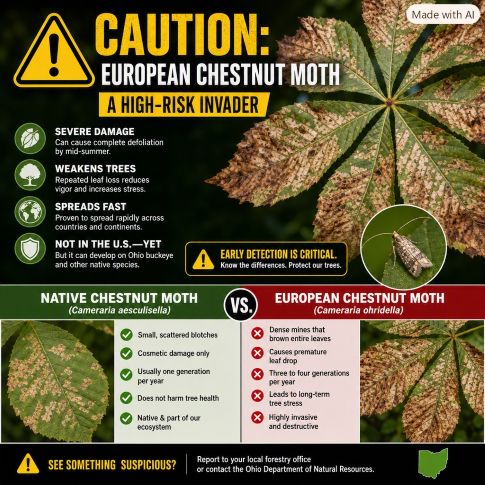
How can you avoid overlooking a dangerous pest? Key Differences. Damage severity. Native species: small, scattered blotches; cosmetic only. European species: dense, overlapping mines that brown entire leaves. Impact on tree health. Native species: no measurable harm. European species: repeated defoliation and long term stress. Generations per year. Native species: typically one. European species: three to four. Spread pattern. Native species: stable, controlled by natural predators. European species: invasive, explosive expansion. Regulatory status. Native species: not monitored; not a pest. European species: high risk exotic pest; USDA watchlisted.
The U.S. has its own chestnut leaf miner, Cameraria aesculisella, a small native moth found in Ohio and neighboring states. It mines leaves too — but the similarities end there.

How can you avoid overlooking a dangerous pest? Key Differences.

How to Tell Them Apart in the Field.

Signs of the harmless native moth:
Small, isolated brown patches.
Leaves remain mostly green.
No premature leaf drop.
Damage appears late in the season.
Signs that would be suspicious for the European moth:
Leaves browning from the inside out.
Dense clusters of mines covering most of the leaf surface.
Trees defoliating in July or August.
Damage spreading rapidly across multiple trees.

If any of these severe symptoms ever appear in Ohio, it would warrant immediate reporting to state forestry officials.

Why This Matters for Homeowners, Landscapers, and Tree Services.

If Cameraria ohridella ever makes its way to the United States, it will likely first appear on ornamental chestnut trees in urban areas. These magnificent trees—which adorn the city with flowering "candles" in the spring and provide relief from the summer heat with their dense foliage—could vanish forever. Chestnut trees in Europe are already facing this very threat.

Early detection would be critical.

For companies like Just Stump It, understanding this distinction is crucial. Invasive pests often lead to the formation of hazardous deadwood, and the stumps of infected trees can serve as overwintering sites for pest pupae.
Ultimately, knowing the difference between natural tree decline and a genuine invasive threat helps protect both our landscapes and our communities. Companies like Just Stump It take this responsibility seriously—removing hazardous deadwood caused by pests and preventing infected stumps from becoming overwintering shelters for future infestations. We do not want to put nature or your property at risk. Let the chestnut trees bloom and continue to bring us joy.
The European chestnut moth is a serious invasive pest abroad, capable of transforming entire landscapes.
The American chestnut moth is harmless, part of our natural ecosystem, and not a threat.
Knowing the difference helps protect local trees — and keeps Ohio prepared for any future introductions.
0 0 votes
Article Rating
Subscribe
Notify of
guest

0 Comments
Oldest
Newest Most Voted
Translate »
0
Would love your thoughts, please comment.x
()
x