Dryad’s Saddle: The “Pretty” Mushroom That Signals a Tree in Trouble
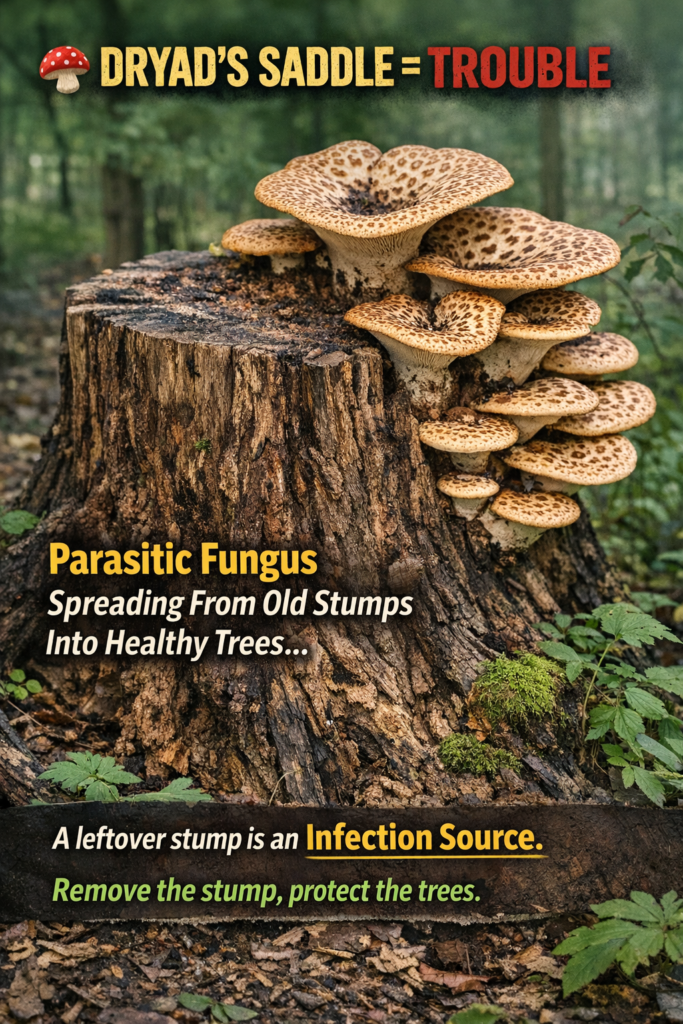
Dryad’s saddle (also called pheasant’s back) may look charming on a stump—but its presence is a warning sign. This fungus is a parasite that spreads from decaying stumps into living trees, slowly eating away their heartwood and leaving them structurally weak.
Once it colonizes a stump, it sends its decay into nearby hardwoods—elm, maple, ash, beech, willow, poplar, and more. As it progresses, it causes white rot, turning the tree’s inner wood soft and spongy. That hidden decay makes trees far more likely to fail in storms.
Dryad’s saddle often begins on dead or dying wood, especially old stumps, then spreads into the living tissue of nearby trees. When it appears on a standing tree, it’s already a sign of internal decay and a compromised structure.
🌳 Why Stump Removal Matters
Leaving a stump behind doesn’t just look messy—it creates a fungal reservoir. Dryad’s saddle thrives on stumps, then uses them as a launchpad to infect healthy trees. Over time, this can turn a single forgotten stump into a neighborhood-wide problem.
Removing the stump removes the source of infection, protecting the rest of your landscape from parasitic fungi that quietly hollow trees from the inside out.

wish you all the best