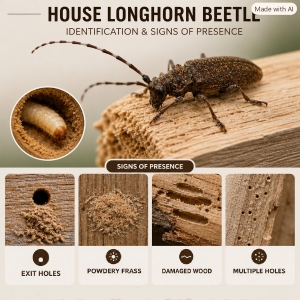
By remaining hidden beneath the surface for several years, a large larva can turn a solid beam into something resembling a sponge. The voracious appetite and secretive nature of the larvae are what make this species so destructive.
Adults (imago). Adult beetles do not feed on wood. Instead, they lay eggs, from which hundreds of larvae hatch.
The house longhorn beetle is considered one of the most dangerous insects that damage structural timber made from coniferous wood. Damage occurs when the larvae bore extensive tunnels inside beams, floor joists, roof trusses, and other coniferous wood components. The outer surface often remains intact, which means an infestation can go unnoticed for a long time—until the timber suddenly collapses under a load.
Because the beetle prefers seasoned softwood, homes with older conifer framing are at higher risk.
Although this species longhorn bettle has adapted well to man-made structures and is considered a common pest in residential buildings, it can also be found in harvested timber, stacks of logs on a property, or untreated lumber intended for construction.
The beetle also maintains its population in the natural environment: it infests dead, dying, or weakened coniferous trees and thrives in coniferous forests. Such habitats serve as reservoirs from which the beetles can spread to nearby structures.
The house longhorn beetle primarily attacks coniferous trees and timber—specifically pine, spruce, and fir. If you notice oval-shaped exit holes in the bark or on exposed wood—typically 6 to 10 mm (¼–⅜ inch) wide—along with fine wood dust (frass) accumulating at the base of the tree, within bark crevices, or near the exit holes, the tree is likely infested and poses an immediate risk. This is especially true if you can see galleries (tunnels) beneath loose bark or within the sapwood.
Another sign to look for is the dieback or weakening of branches, caused by internal damage to the wood. While this does not definitively indicate a pest infestation, it is a reason to take a closer look at the tree’s overall health.
Woodpeckers and other birds may peck at infested trees to reach the larvae. Have you noticed an increase in their activity? If so, look for other signs of infestation, and keep an eye out for adult home longhorn beetles in the vicinity during the summer months.
If you discover signs that a tree is infected, take urgent measures to prevent an epidemic.