• (216) 767-6323
  • office@juststumpit.com
  • OHIO

Spongy Moth in Ohio: What Homeowners Need to Know.
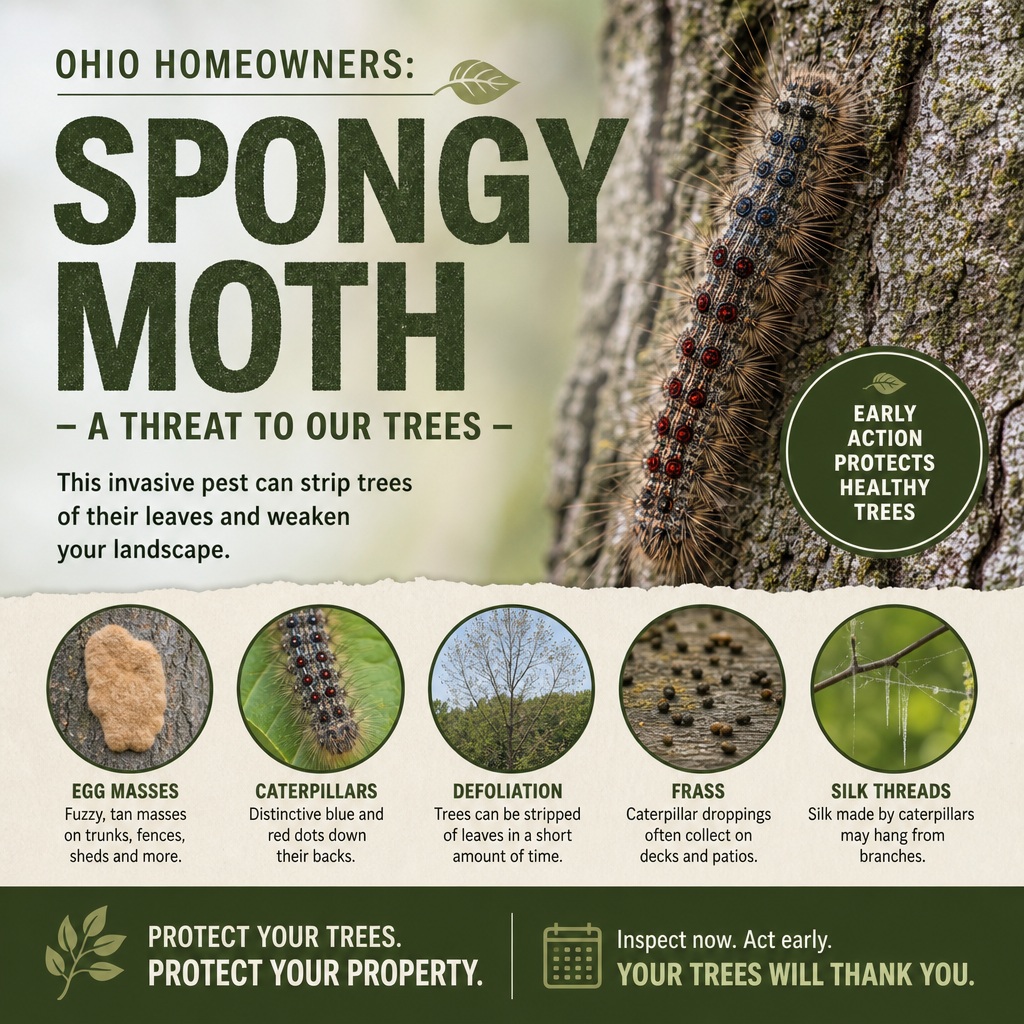
Did you come across any caterpillars with red and blue dots on their backs this summer?

Did you come across any caterpillars with red and blue dots on their backs this summer? Ohio’s trees are facing a stubborn invader: the spongy moth. This pest has been spreading across Northeast Ohio, and its damage is becoming more visible in neighborhoods from Parma Heights to Lakewood and beyond.

🐛 What Makes the Spongy Moth a Threat?
The spongy moth’s caterpillars are voracious feeders, capable of stripping entire trees bare.
They feed on over 300 plant species, but in our region, they are particularly fond of oak and maple. The caterpillars are also frequently found on willows and birches. Fruit trees in orchards and young ornamental plantings near homes are likewise susceptible to attacks by this pest.
A single caterpillar can consume about a square foot (approx. 0.1 sq. m) of foliage per day, and during a mass infestation, a mature tree can be completely defoliated in just one week.
A healthy tree can survive one season of defoliation—but repeated attacks weaken the tree’s immune system, making it vulnerable to cankers and bacterial infections. A weakened tree has a reduced capacity for transpiration. Diseases and nutrient deficiencies significantly shorten its lifespan.
For young trees or recently planted ornamentals, a single heavy infestation can be fatal.
Spongy moth egg masses appear as fuzzy, yellowish-brown clusters on tree trunks, fences, sheds, and garden furniture. You may also notice their droppings accumulating on decks and patios.

How to Spot an Infestation

Spongy moth egg masses appear as fuzzy, yellowish-brown clusters on tree trunks, stumps, fences, sheds, and garden furniture. You may also notice their droppings accumulating on decks and patios.
An infested tree experiences heavy leaf drop in late spring and early summer. If you also see long, silky threads hanging from the branches, your tree may already be under severe stress.

A Strong Yard Starts With Healthy Trees

A Strong Yard Starts With Healthy Trees

The spongy moth is here, and it’s spreading—but early action can protect your landscape. If you’re seeing egg masses, defoliation, or suspicious caterpillars, it’s time to get ahead of the problem before it becomes a full season battle.

Grinding down tree stumps can help combat the gypsy moth by eliminating a key breeding site where the insects lay their egg masses. Removing these stumps destroys the overwintering eggs, thereby reducing the population of the pest and limiting its potential to spread to surrounding trees.

Have you spotted gypsy moth activity on your property?

We’d love to hear your experience. What did you notice first — egg masses, caterpillars, or leaf damage?
What steps did you take to handle it, and how did things turn out for your trees afterward?
Your story could help other homeowners understand what works, what doesn’t, and how to stay ahead of this pest in our area.

0 0 votes
Article Rating
Subscribe
Notify of
guest

0 Comments
Oldest
Newest Most Voted
Translate »
0
Would love your thoughts, please comment.x
()
x