• (216) 767-6323
  • office@juststumpit.com
  • OHIO

New Service: Landscape Design After Stump Grinding
Your yard doesn’t have to stop at “stump removed.” We now offer landscape design services to help you transform that newly cleared space into something beautiful, functional, and tailored to your property.
Two Levels of Design
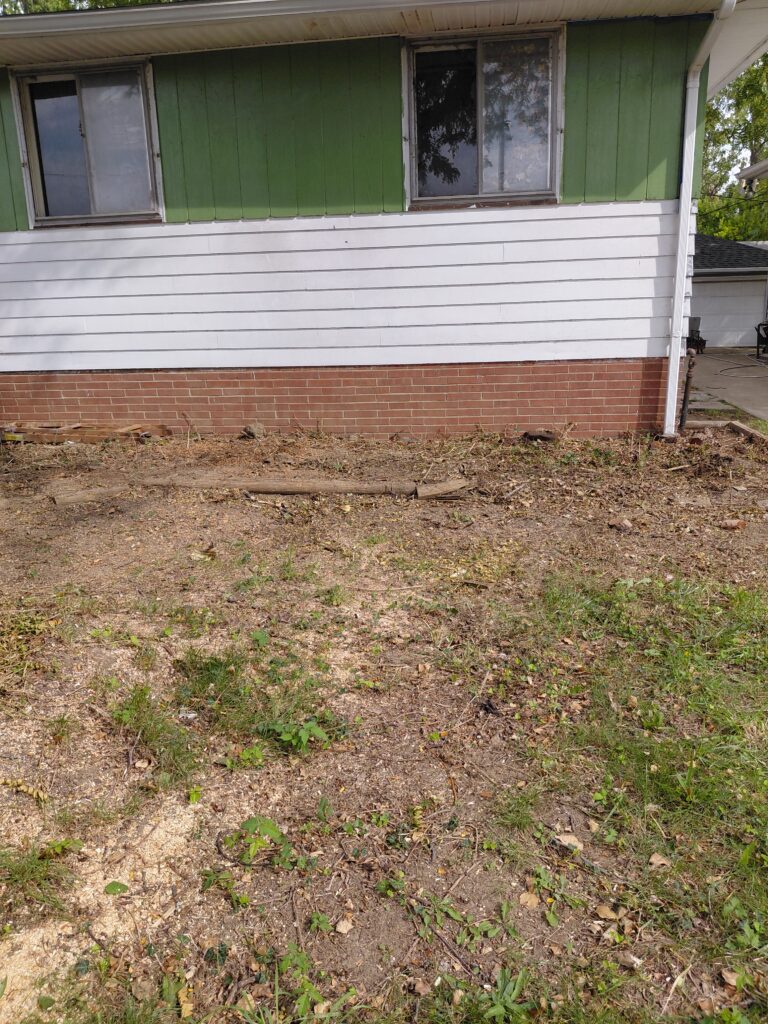
Existing Yard Area (Before Photos) The photos show a cleared planting bed along the front/side wall of a split-level home with white horizontal siding, green upper accent panels, and a red brick foundation. Key features visible: A large, mostly bare dirt planting area extending the length of the wall. Evidence of recent stump grinding and vegetation removal, including wood chips, sawdust, roots, and scattered plant debris. An old timber landscape border running horizontally through part of the bed. Sparse patches of grass and weeds emerging throughout the area. A downspout at the right corner of the house near a concrete driveway. Two windows overlooking the planting bed. Full to partial sun exposure based on the visible shadows and lighting conditions. An open, unobstructed space suitable for redevelopment into a landscaped garden bed.
Care Instructions for the Foundation Landscape First Year Establishment The first year is the most important for helping plants develop strong root systems. Watering Water deeply 2 to 3 times per week during the first growing season. Apply approximately 1 inch of water per week from rainfall and irrigation combined. During hot summer periods (above 85°F), check soil moisture every few days. Water at the base of plants rather than overhead to reduce disease risk. Mulching Maintain a 2 to 3-inch layer of hardwood mulch throughout the bed. Keep mulch 2 to 3 inches away from trunks and stems to prevent rot. Refresh mulch annually in spring. Shrub Care Limelight and Little Lime Hydrangeas Spring Prune in late winter or early spring before new growth appears. Reduce stems by about one-third to encourage stronger blooms. Summer Water during dry periods. Deadheading is optional since blooms provide fall and winter interest. Fall/Winter Leave blooms intact for winter structure. Remove old flower heads in spring. Japanese Maple Watering Deep water weekly during the first two growing seasons. Pruning Remove dead or crossing branches during late winter. Avoid heavy pruning. Protection Keep mulch around the root zone. Protect from lawn equipment damage. Serviceberry Tree Pruning Remove dead, damaged, or crossing branches in late winter. Preserve natural multi-stem form. Fertilizing Generally not required if planted in quality soil. Perennial Care Salvia After First Bloom Cut flower spikes back by half. Often produces a second flush of blooms. Spring Cleanup Remove dead growth before new shoots emerge. Catmint Mid-Summer Shear plants back by one-third after blooming. Encourages fresh foliage and repeat flowering. Spring Cut old stems to 3 to 4 inches. Sedum 'Autumn Joy' Spring Cut stems to ground level before new growth appears. Summer Minimal maintenance. Avoid excessive watering. Hostas Watering Keep soil evenly moist. Fall Remove spent foliage after frost. Slug Prevention Apply slug bait if damage occurs. Ornamental Grass Care Hameln Fountain Grass Late Winter/Early Spring Cut back to 4 to 6 inches before new growth starts. Division Divide every 4 to 5 years if plants become crowded. Water Feature Maintenance Bubbling Urn Fountain Weekly Check water level. Remove leaves and debris. Monthly Clean pump intake and reservoir. Winter Drain completely or remove pump before freezing temperatures. Seasonal Maintenance Schedule Early Spring (March-April) ✓ Prune hydrangeas ✓ Cut back grasses ✓ Remove perennial debris ✓ Apply fresh mulch ✓ Inspect irrigation and fountain Late Spring (May-June) ✓ Apply slow-release fertilizer if desired ✓ Check for weeds ✓ Edge beds Summer (July-August) ✓ Deep watering during dry periods ✓ Deadhead Salvia ✓ Trim Catmint after bloom ✓ Monitor for pests Fall (September-November) ✓ Remove fallen leaves ✓ Reduce watering as temperatures cool ✓ Leave ornamental grasses and hydrangea blooms for winter interest Winter (December-February) ✓ Drain fountain ✓ Inspect trees for storm damage ✓ Plan any additions or plant replacements Long-Term Expectations Plant Time to MatureHydrangeas 3-5 years Japanese Maple 5-10 years Serviceberry 5-7 years Ornamental Grass 2-3 years Salvia & Catmint 2 years Hostas 3 years With proper watering and mulching during the first two years, this landscape should provide attractive blooms, texture, and structure with only a few hours of maintenance each month.
Approximate appearance of the flowerbed on the site after stump grinding. A focused, budget friendly plan perfect for smaller areas or simple upgrades.
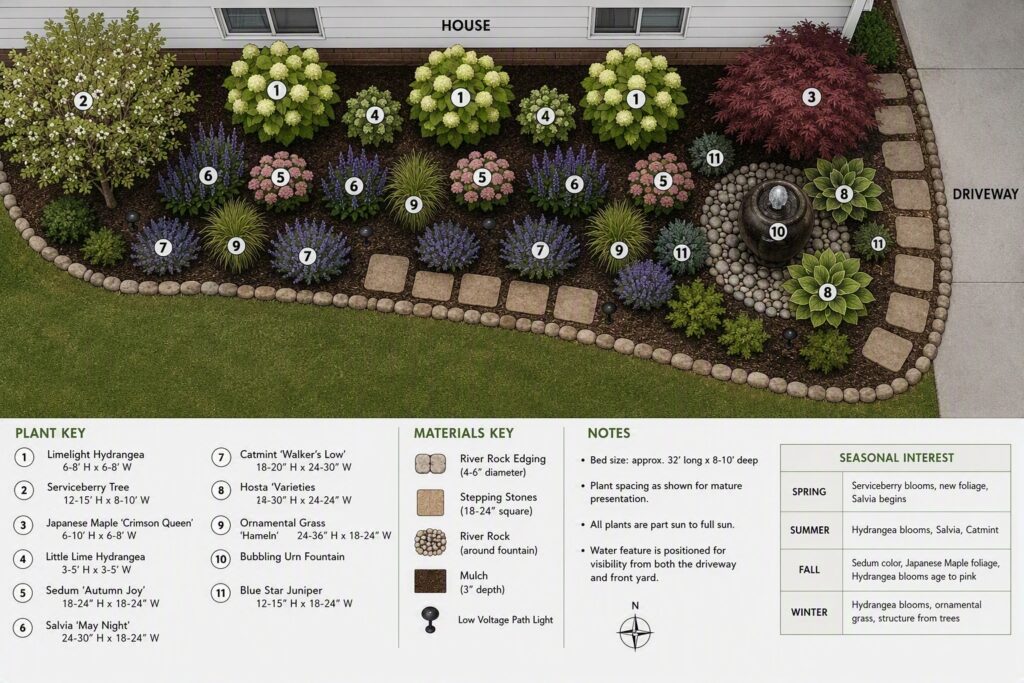
Foundation Bed Planting Plan.
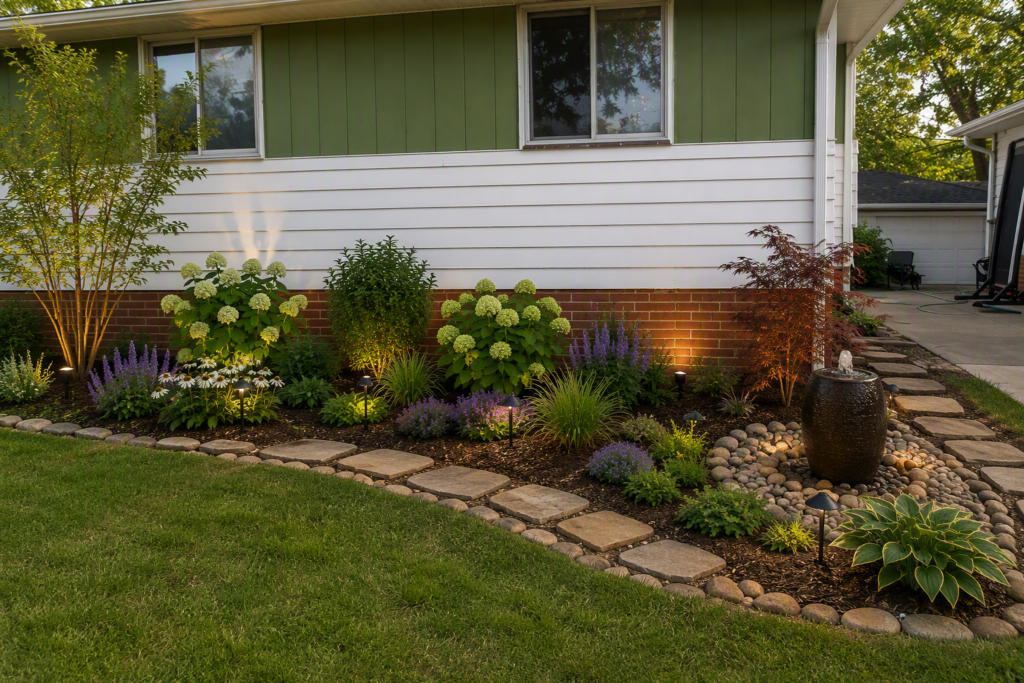
Based on the rendered landscape design, this planting plan provides four-season interest, low maintenance, and balanced scale for the front elevation.
Bed Dimensions.
Approximate bed size: 30-35 ft long × 8-10 ft deep
Shape: Curved foundation bed with stone edging
Sun exposure: Part sun to full sun
Back Layer (Against House)
Limelight Hydrangea
Quantity: 3
Placement:
One below left window
One centered between windows
One near right side of foundation
Mature Size: 6-8 ft tall, 6-8 ft wide.
Season Interest: summer white blooms and pink fall color.
Japanese Maple
Quantity: 1
Placement: Right corner near driveway
Recommended Variety:
Crimson Queen or Tamukeyama
Mature Size: 6-10 ft tall
Purpose: Creates focal point and softens corner.
Serviceberry or Multi-Stem Tree.
Quantity: 1
Placement: Left side of bed
Mature Size: 12-15 ft
Benefits: Spring flowers, fall color, wildlife friendly.
Mid Layer
Little Lime Hydrangea
Quantity: 2
Placement: Between larger hydrangeas
Mature Size: 3-5 ft
Autumn Joy Sedum
Quantity: 3
Placement: Drifts throughout middle layer
Mature Size: 18-24 in
Benefits: Drought tolerant, excellent fall color
Salvia May Night
Quantity: 3
Placement: Clusters around hydrangeas
Bloom Color: Deep purple
Bloom Period: Late spring through summer
Front Layer
Catmint Walker’s Low
Quantity: 7-9
Placement: Along front edge
Benefits: Long blooming, softens stone border
Hosta
Quantity: 2
Placement: Around water feature
Varieties: Patriot, June, Halcyon
Benefits: Lush, vibrant foliage, easy care, blooms all summer long.
Ornamental Grass
Quantity: 3
Recommended Variety: Hameln Fountain Grass
Placement: Alternating through middle/front bed
Mature Size: 2-3 ft
Water feature area:
A fountain surrounded by hostas and ‘Blue Star’ juniper.
River rock basin
Creates a dedicated focal point visible from both the driveway and street.
Ground Cover & Mulch
Mulch 3″ dark brown or black
Edging natural river rock edging 4-6″ diameter stones
Layout Diagram
We are launching a new series: "What can you do after stump grinding?" Here is a brief glimpse of our work from yesterday as a first example. Active restoration work is currently underway at the site. What do you think of this design project?
This plan would create a layered landscape with spring flowers, summer blooms, fall color, winter structure, and a strong focal point at each end of the house. It is also well-suited to Northweast Ohio’s climate.
Care Instructions for the Foundation Landscape.
First Year Establishment.
The first year is the most important for helping plants develop strong root systems.
Watering
Water deeply 2 to 3 times per week during the first growing season. Apply approximately 1 inch of water per week from rainfall and irrigation combined. During hot summer periods (above 85°F), check soil moisture every few days. Water at the base of plants rather than overhead to reduce disease risk.
Mulching
Maintain a 2 to 3-inch layer of mulch throughout the bed. Keep mulch 2 to 3 inches away from trunks and stems to prevent rot. Refresh mulch annually in spring.
Shrub Care
Limelight and Little Lime Hydrangeas
Spring
Prune in late winter or early spring before new growth appears. Reduce stems by about one-third to encourage stronger blooms.
Summer
Water during dry periods. Deadheading is optional since blooms provide fall and winter interest.
Fall/Winter
Leave blooms intact for winter structure. Remove old flower heads in spring.
Fertilization
Begin applying fertilizer in early spring, when the buds on the stems begin to swell. Apply a second dose when the leaves are unfurling and flower clusters are forming; choose a blend formulated for flowering shrubs.
Apply a third dose in the summer to ensure high-quality flowering.
In the autumn, ensure the fertilizer contains no nitrogen to facilitate successful overwintering.
While nitrogen-rich fertilizers are used in spring to accelerate shoot growth, potassium and phosphorus predominate in summer and autumn—these elements are responsible for healthy roots and abundant blooms.
Japanese Maple
Watering
Deep water weekly during the first two growing seasons.
Pruning
Remove dead or crossing branches during late winter. Avoid heavy pruning.
Protection
Keep mulch around the root zone. Protect from lawn equipment damage.
Fertilizing
Generally not required if planted in quality soil. If necessary, apply fertilizers designed for acid-loving plants.
Serviceberry Tree
Pruning
Remove dead, damaged, or crossing branches in late winter. Preserve natural multi-stem form.
Fertilizing
Generally not required if planted in quality soil. Once the shrub reaches 4–5 years of age, if signs of nutrient deficiency appear, apply fertilizer for flowering trees and shrubs to the root zone annually in the spring and in the second half of July.
Perennial Care
Salvia
After First Bloom
Cut flower spikes back by half. Often produces a second flush of blooms.
Spring Cleanup
Remove dead growth before new shoots emerge.
Catmint
Mid-Summer
Shear plants back by one-third after blooming. Encourages fresh foliage and repeat flowering.
Spring
Cut old stems to 3 to 4 inches.
Sedum ‘Autumn Joy’
Spring
Cut stems to ground level before new growth appears.
Summer
Minimal maintenance. Avoid excessive watering.
Hostas
Watering
Keep soil evenly moist.
Fall
Remove spent foliage after frost.
Slug Prevention
Apply slug bait if damage occurs.
Ornamental Grass Care
Hameln Fountain Grass
Late Winter/Early Spring
Cut back to 4 to 6 inches before new growth starts.
Division
Divide every 4 to 5 years if plants become crowded.
Water Feature Maintenance
Bubbling Urn Fountain
Weekly check water level. Remove leaves and debris.
Monthly clean pump intake and reservoir.
Winter drain completely or remove pump before freezing temperatures.
Seasonal Maintenance Schedule
Early Spring (March-April)
✓ Prune hydrangeas
✓ Cut back grasses
✓ Remove perennial debris
✓ Apply fresh mulch
✓ Inspect irrigation and fountain
Late Spring (May-June)
✓ Apply slow-release fertilizer if desired
✓ Check for weeds
✓ Edge beds
Summer (July-August)
✓ Deep watering during dry periods
✓ Deadhead Salvia
✓ Trim Catmint after bloom
✓ Monitor for pests
Fall (September-November)
✓ Remove fallen leaves
✓ Reduce watering as temperatures cool
✓ Leave ornamental grasses and hydrangea blooms for winter interest
Winter (December-February)
✓ Drain fountain
✓ Inspect trees for storm damage
✓ Plan any additions or plant replacements
Long-Term Expectations
Timelines for plant maturation.
Hydrangeas 3-5 years
Japanese Maple 5-10 years
Serviceberry 5-7 years
Ornamental Grass 2-3 years
Salvia & Catmint 2 years
Hostas 3 years
With proper watering and mulching during the first two years, this landscape should provide attractive blooms, texture, and structure with only a few hours of maintenance each month.
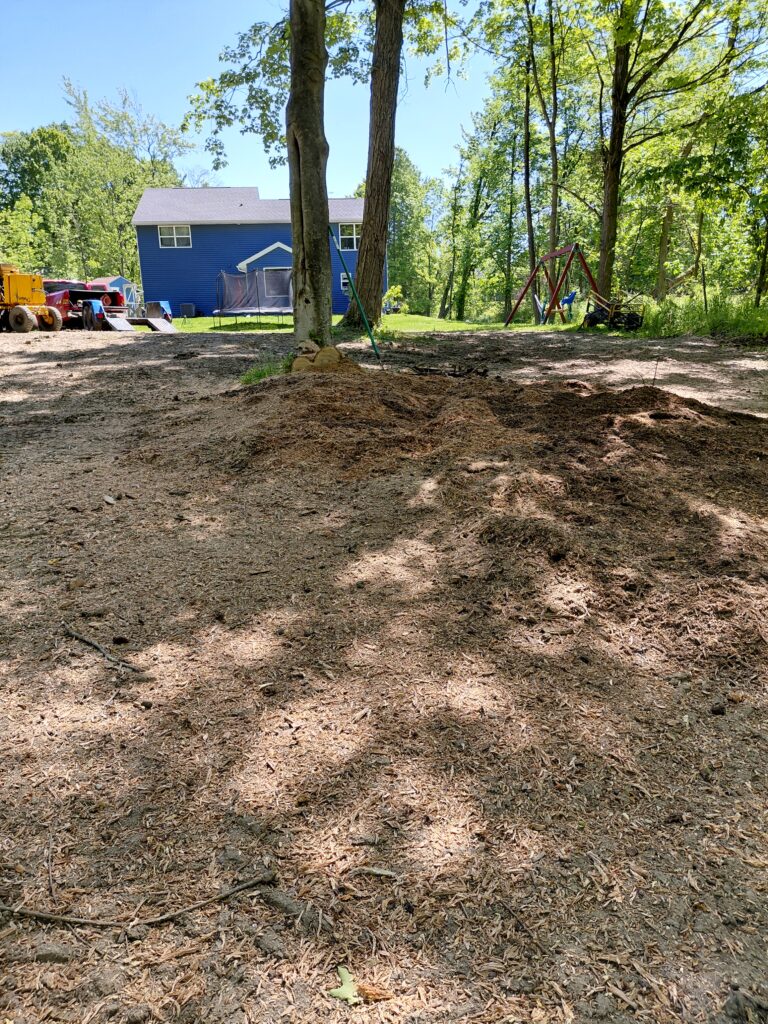
Backyard Landscaping Design Project — Woodland Clearing to Usable Space. This is a technical specification for landscape design; it can be handed over to the work crew. Project Vision Transform this partially cleared, stump‑removal zone into a structured, usable backyard that still honors the natural woodland feel. The goal is to: - Clean up the work zone (chips, soil disruption, stump remnants) - Create a defined gathering or functional area - Add plantings that thrive in partial shade - Introduce order without losing the forest charm - Make the space feel intentional, not “recently worked on”
Open clearing ideal for a defined feature zone. Opportunities. - Natural tree canopy creates a cozy, shaded microclimate - Clearing provides a blank canvas for seating, fire pit, or garden beds - Wood chips can be repurposed as mulch or compost.
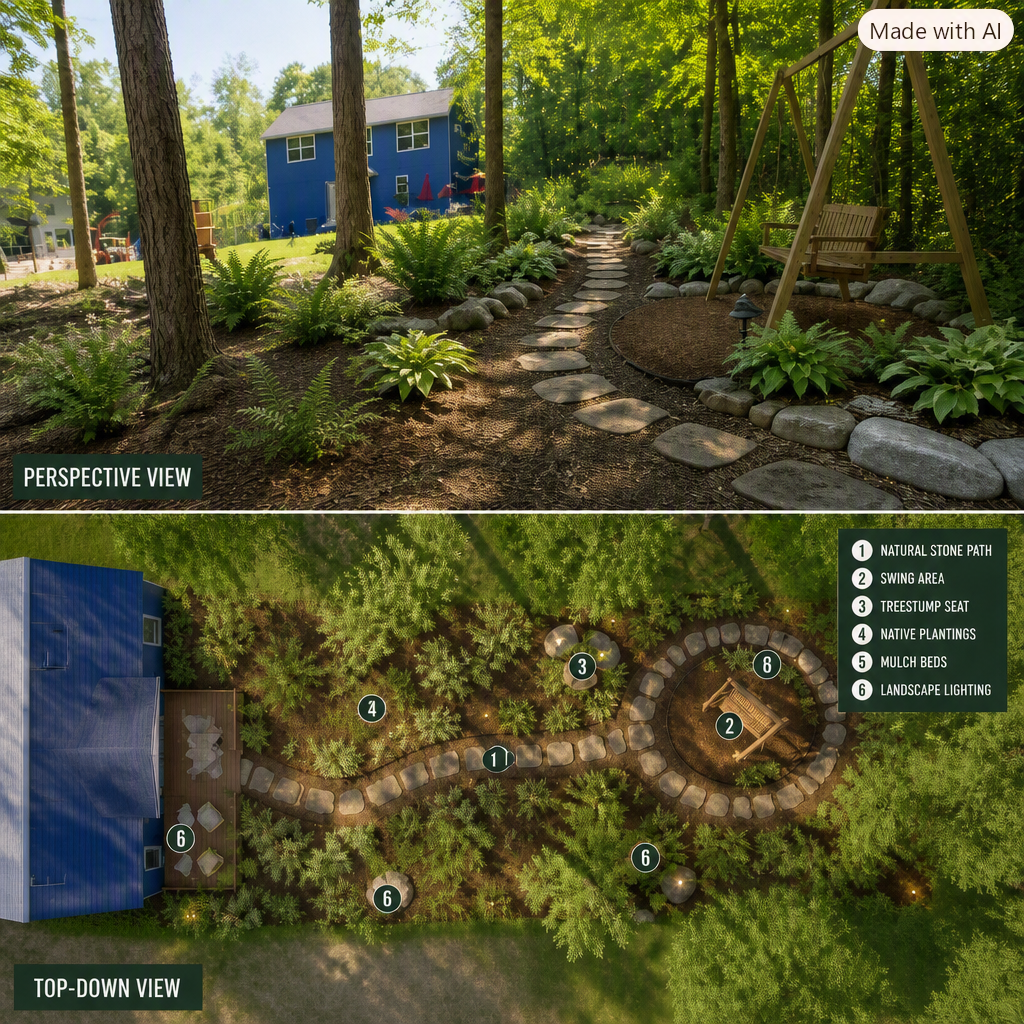
Backyard Plan. A more comprehensive design for larger spaces, full transformations, and long term landscape vision. Paint us a rough picture of what you’d love to see, and we’ll turn it into a plan you can build on.
Backyard Landscaping Design Project — Woodland Clearing to Usable Space.
This is a technical specification for landscape design; it can be handed over to the work crew.
Project Vision
Transform this partially cleared, stump‑removal zone into a structured, usable backyard that still honors the natural woodland feel.
The goal is to:
Clean up the work zone (chips, soil disruption, stump remnants)
Create a defined gathering or functional area
Add plantings that thrive in partial shade
Introduce order without losing the forest charm
– Make the space feel intentional, not “recently worked on”
Open clearing ideal for a defined feature zone.
Opportunities.
Natural tree canopy creates a cozy, shaded microclimate
Clearing provides a blank canvas for seating, fire pit, or garden beds
Wood chips can be repurposed as mulch or compost.
Proposed Layout Plan.
Clean & Reset
Rake and redistribute wood chips into planting beds
Regrade soil to smooth tire tracks and level the clearing
Add a weed barrier only where you want structured beds
Anchor Feature Zone (Center of Clearing)
Choose one primary use:
Option 1 — Fire Pit + Seating Circle
Crushed limestone or pea gravel pad (12–16 ft diameter)
Natural log or Adirondack seating
Low-voltage string lights hung from trees
Option 2 — Woodland Patio
Flagstone or irregular bluestone
Moss or creeping thyme between stones
Perfect for a bistro set or hammock stand
Option 3 — Native Shade Garden
Curved beds around the clearing
Pathway of mulch or stone leading through
Great for pollinators and low maintenance
Planting Plan (Shade‑Friendly + Woodland‑Appropriate)
Structural Shrubs:
Oakleaf Hydrangea
Inkberry Holly
Winterberry (adds color in winter)
Perennials:
Hosta (blue, variegated, or giant varieties)
Astilbe (pink/white plumes)
Ferns (lady fern, ostrich fern)
Heuchera (plum, caramel, or moss tones)
Groundcovers:
Sweet Woodruff
Pachysandra
Creeping Jenny (chartreuse pop)
Accent Trees (Optional):
Serviceberry
Redbud
Dogwood
Hardscape & Materials.
Edging: natural stone or black metal
Mulch: dark brown or black to contrast the woodland floor
Pathways: crushed gravel or stepping stones
Lighting: solar uplights + warm string lights
Color Palette
Greens: moss, sage, deep forest
Accents: cream, blush, dusty lavender
Hardscape: charcoal, natural stone, matte black
Seasonal pops: hydrangea white/pink, astilbe plumes, heuchera plum
Contractor‑Ready Task List:
Regrade soil + smooth tracks
Redistribute wood chips
Install feature zone (fire pit, patio, or garden)
Build curved planting beds
Add shrubs + perennials
Install edging
Add mulch
Add lighting + optional seating
Detailed plans for each design aspect will be attached to the project, including the selection of plants and materials, as well as descriptions and recommendations.
Paint us a rough picture of what you’d love to see, and we’ll turn it into a plan you can build on.
When ordering a landscape design service after stump removal, it helps to discuss a few key points with your designer: the areas you want to improve, any drainage or soil concerns, how much sun the space gets, the style you prefer for flowerbeds, your color and plant preferences, the level of maintenance you’re comfortable with, and whether you want year‑round interest or seasonal highlights. Sharing your budget, timeline, and any inspiration photos also ensures the final plan matches your vision and works beautifully with the newly cleared space.
Pricing varies by project complexity. Whether you want a simple planting plan or a full backyard redesign, we’ll help you make the most of the space reclaimed after stump grinding.
0 0 votes
Article Rating
Subscribe
Notify of
guest

0 Comments
Oldest
Newest Most Voted
Translate »
0
Would love your thoughts, please comment.x
()
x