• (216) 767-6323
  • office@juststumpit.com
  • OHIO

The Ash Borer Beetle. A Small Insect With Massive Impact.
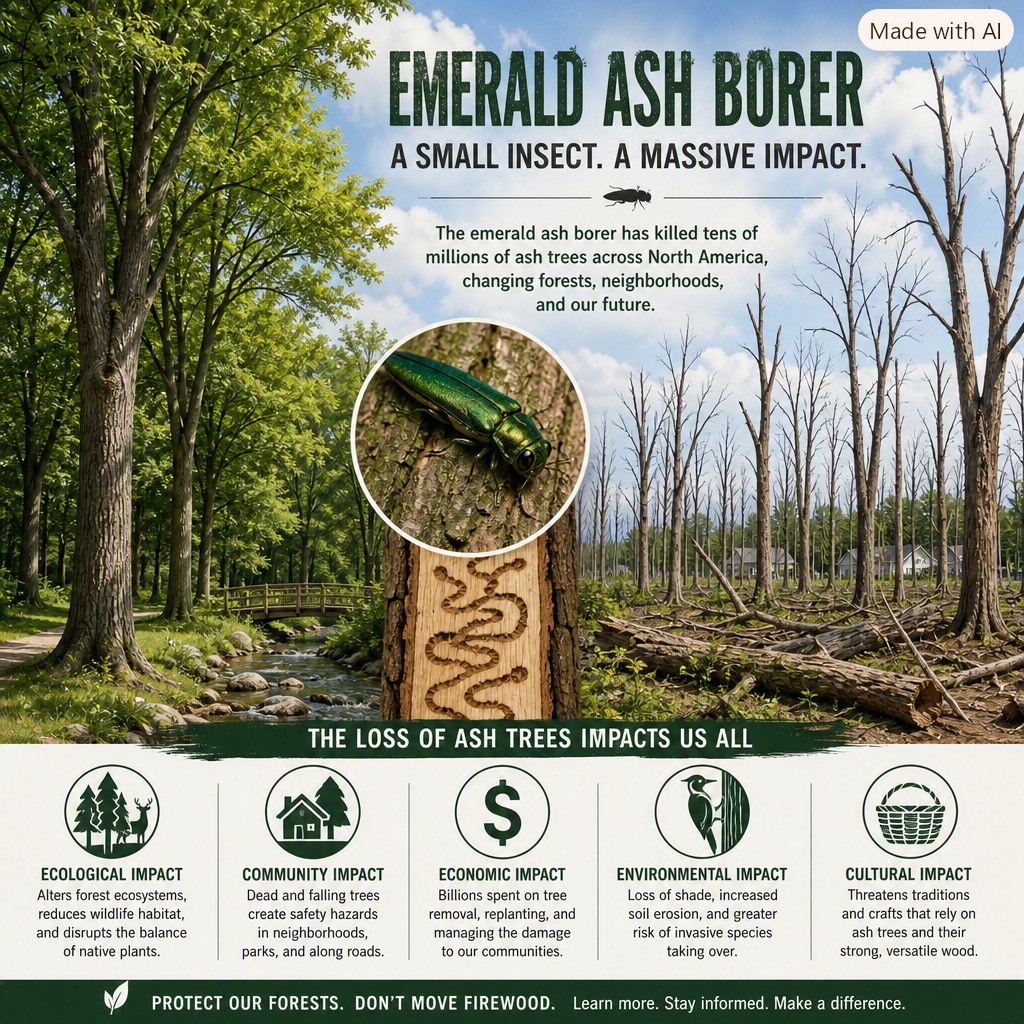
The emerald ash borer (Agrilus planipennis), commonly called the ash borer beetle, is one of the most destructive invasive insects ever introduced to North America. Since its arrival, it has killed tens of millions of ash trees across the United States and Canada, reshaping forests, neighborhoods, and city landscapes.

What Is the Ash Borer Beetle?

The ash borer beetle is a metallic-green wood‑boring insect native to East Asia. Adults are slender, about ½ inch long, with a bright emerald sheen and a copper‑red abdomen.
Although the adults feed on ash leaves, the real damage comes from the larvae. After hatching, larvae burrow beneath the bark and feed on the tree’s phloem and outer sapwood, carving distinctive S‑shaped galleries that disrupt the tree’s ability to transport water and nutrients. This internal damage eventually girdles and kills the tree.

The emerald ash borer naturally occurs in China, eastern Russia, Mongolia, Taiwan, Japan, and Korea. It was accidentally introduced to North America in the 1990s and first detected in 2002 in southeast Michigan.
Since then, it has spread rapidly across the U.S. and Canada, aided by both natural movement and human transport of infested firewood. Today, infestations have been confirmed in 38 states and the District of Columbia.
The ash borer beetle is a metallic-green wood‑boring insect native to East Asia. Adults are slender, about ½ inch long, with a bright emerald sheen and a copper‑red abdomen. Although the adults feed on ash leaves, the real damage comes from the larvae. After hatching, larvae burrow beneath the bark and feed on the tree’s phloem and outer sapwood, carving distinctive S‑shaped galleries that disrupt the tree’s ability to transport water and nutrients. This internal damage eventually girdles and kills the tree. Signs of Infestation: Ash trees often decline slowly, making early detection difficult. Key symptoms include: Dead branches near the top of the tree. Vertical bark cracks. Excessive sprouting along the trunk. D‑shaped exit holes left by emerging adults. S‑shaped larval tunnels beneath the bark. Increased woodpecker activity, as they feed on larvae beneath the bark.

Ash tree dieback often occurs gradually, making the problem difficult to detect at an early stage. If you own an ash tree, watch for signs of infestation:

Dieback of branches in the upper crown.
Vertical cracks in the bark.
Prolific shoot growth on the trunk.
D-shaped exit holes left by adult insects.
S-shaped larval galleries beneath the bark.
Increased woodpecker activity as they hunt for larvae under the bark.
Infested trees typically die within two to four years.

Remove the risk of spreading tree diseases by using only locally sourced or certified heat‑treated firewood. Avoid transporting firewood over long distances, and familiarize yourself with early signs of infestation. If a tree becomes diseased and must be taken down, eliminate every remnant — including firewood and the stump — so the infection cannot linger on your property.
Insecticide treatments are available for valuable ash trees, though timing and proper application are critical. Local Cooperative Extension offices can help homeowners evaluate treatment options.
Once an ash tree is heavily infested, removal is often the safest option—especially near homes, sidewalks, or roads. Dead ash trees deteriorate rapidly and can fail without warning.
If you suspect ash borer activity, you can report it to federal or state agencies. The USDA maintains a national reporting hotline at 1‑866‑322‑4512.

Protecting Our Local Landscapes

The emerald ash borer continues to reshape forests and neighborhoods across the country. In the Cleveland area—where ash trees once lined streets, parks, and backyards—awareness and early action are essential. Whether you’re a homeowner, land manager, or simply a nature lover, staying informed helps protect our community’s trees and the ecosystems they support.

0 0 votes
Article Rating
Subscribe
Notify of
guest

0 Comments
Oldest
Newest Most Voted
Translate »
0
Would love your thoughts, please comment.x
()
x