• (216) 767-6323
  • office@juststumpit.com
  • OHIO

How Transpiration Changes With Plant Age — And How to Build a Strong, Long Lasting Biodrainage System
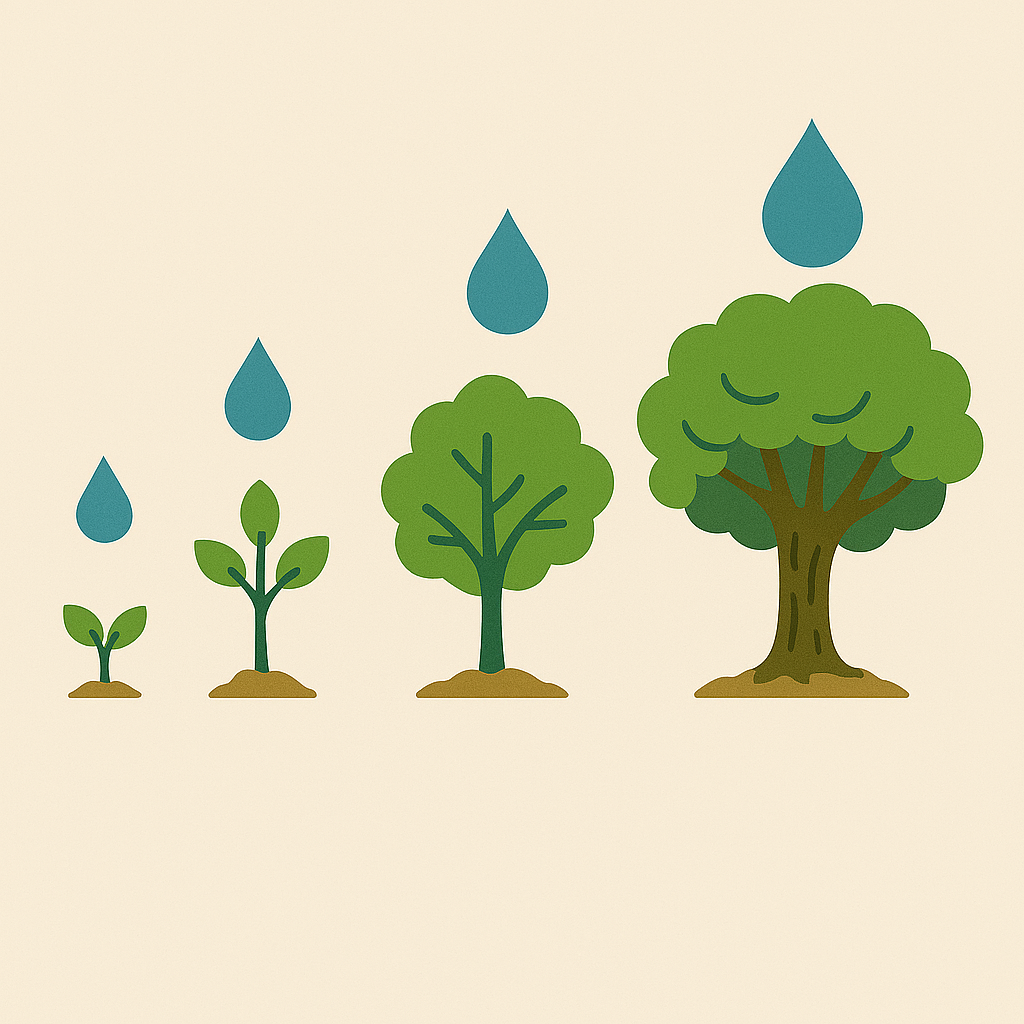
There is no fixed “expiration date” for biodrainage plants, but their effectiveness follows a predictable curve tied to age, canopy size, and root vigor. The goal is to replace a plant before its water‑use capacity declines.

Biodrainage is one of the most natural and effective ways to manage excess groundwater on a property. But here’s the part most homeowners never hear: a plant’s ability to move water isn’t constant throughout its life. Transpiration—the process of pulling water from the soil and releasing it through the leaves—rises, peaks, and eventually declines as a tree ages.

Understanding these age related changes is the key to designing a biodrainage system that stays effective for decades. Even better, you can compensate for declining water use by combining different plant ages and species so your yard never loses its natural drainage power.
Let’s break it down in a way that’s easy for homeowners to understand.

Young Plants: Low Transpiration, High Potential.

Young trees and shrubs (0–5 years) are still establishing their root systems. Their small crowns and limited leaf surface area are unable to transpire sufficient amounts of water; they cannot yet shoulder the main workload. However, their rapid growth rate makes them valuable for the future development of your biodrainage system.

From young to mature trees: peak biodrainage efficiency.

This is the most productive period. Between the ages of approximately 10 and 30 (depending on the species), trees—with their expansive, dense crowns and deep, powerful root systems—reach their maximum daily rates of water transport.

Trees are unmatched in their ability to move water. A single mature, high‑water‑use tree can evaporate **tens of gallons of water a day** through its leaves. No pump, pipe, or drain works as quietly or as continuously. Their deep roots pull moisture from saturated soil, and their broad canopies release it back into the air — turning excess groundwater into clean vapor. This natural process is why biodrainage succeeds where traditional drainage systems often fall short.

A mature willow, birch, or poplar can pump tens of gallons of water per day, making trees of this age the cornerstone of any biodrainage system.
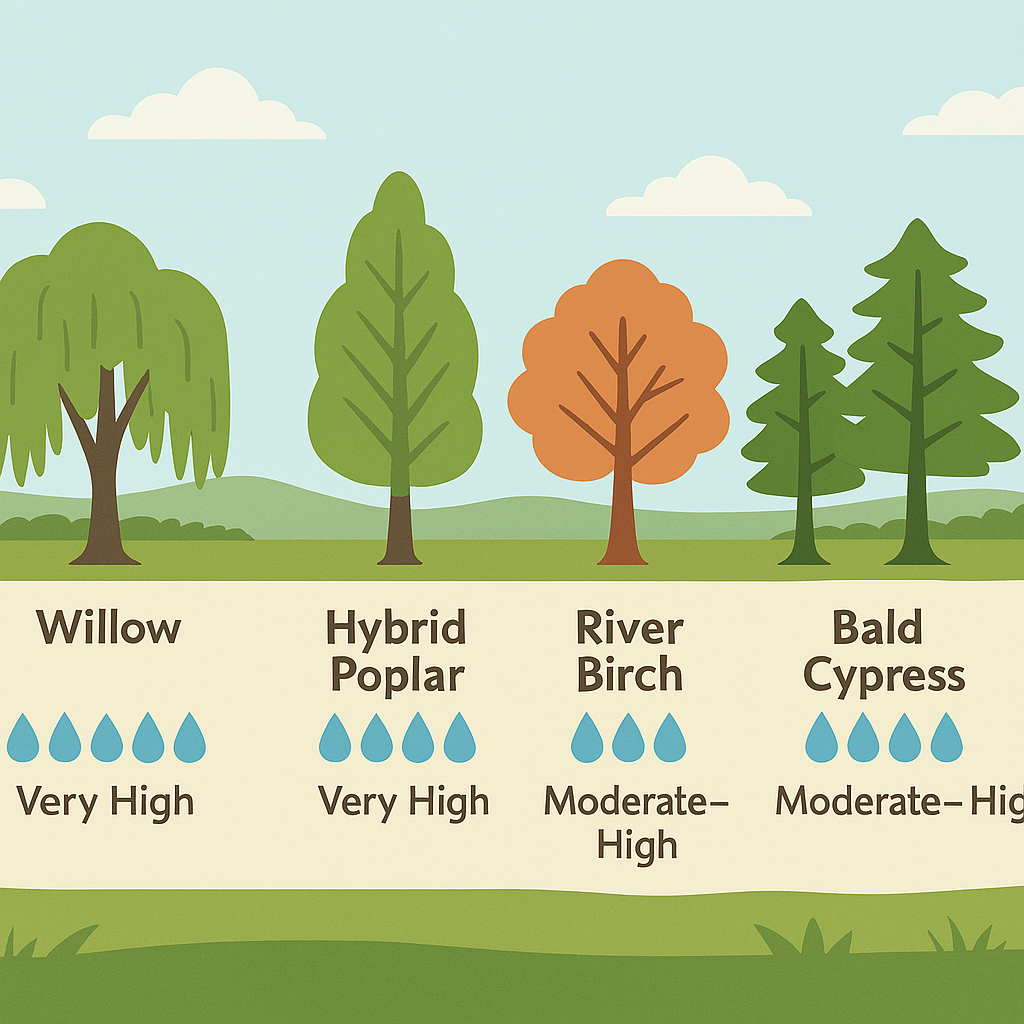
Some species naturally use far more water than others. Together, these traits allow certain trees and shrubs to significantly reduce soil moisture and lower groundwater levels over time.
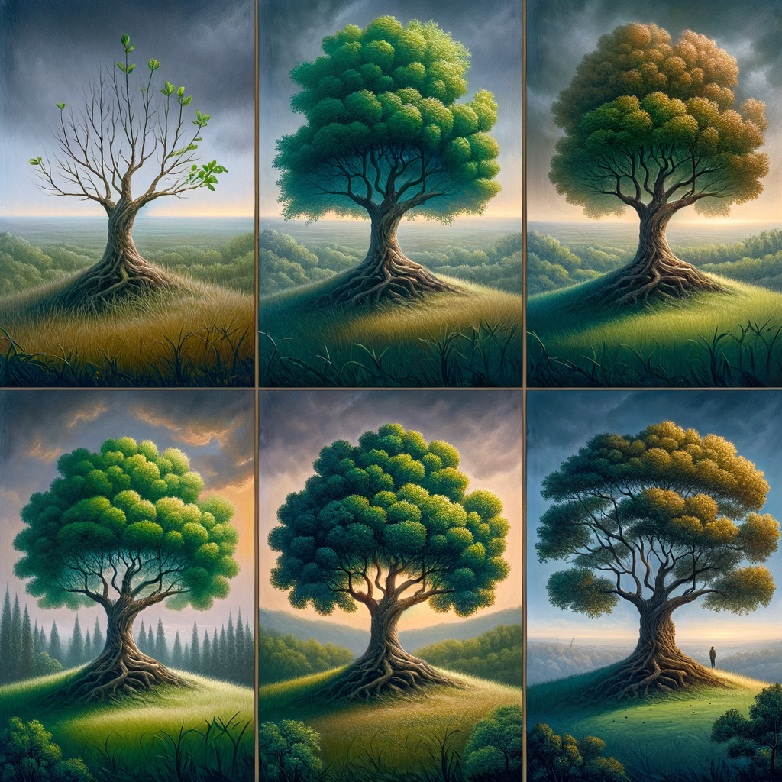
Aging and Declining Trees: Reduced Transpiration. As trees move into their later decades, their ability to transpire drops significantly.
Weakened, aging trees are often afflicted by fungi that cause internal rot and root dieback. The resulting slowdown in sap flow leads to a thinning of the crown, which reduces the leaf surface area available for transpiration.
Even if the tree still appears large, its water transport mechanisms slow down. A declining tree may transpire only half—or even less—of the moisture it did during its prime. This is why many homeowners notice groundwater problems returning after years of stability—the tree is simply aging out of its biodrainage role.
A biodrainage system is only as strong as the active transpiration happening in the yard. If your system relies on one or two aging trees, its effectiveness will drop long before the tree actually dies.
But there is good news: You can create a system that never loses its effectiveness by combining plants of different ages and species—and by replacing those that have lost their effectiveness in a timely manner.

🌳 How to Maintain Biodrainage Efficiency: Combine Ages + Combine Species

Mix Young, Middle Aged, and Mature Plants.
Think of it like a relay race:
Young plants are the future.
Middle aged plants are the workhorses.
Older plants provide shade and structure but need backup.
By planting in staggered age groups, you ensure that as older trees decline, younger ones are already stepping into their peak transpiration years.
Different species age at different speeds.
Fast, high water use species (short lived):
– Willows
– Hybrid poplars
– River birch
These hit peak transpiration early but decline sooner.
Slower, long lived species (steady performers):
– Swamp white oak
– Bald cypress
– Red maple
These take longer to mature but provide decades of stable water use.
The best biodrainage systems use both.
Fast growers handle the immediate water problem. Long lived species take over as the fast growers age out.
You don’t need to wait for a tree to die. If the canopy is thinning or the tree is past its prime growth phase, its transpiration is already dropping. Replacing older trees every 20–40 years (species dependent) keeps your biodrainage system strong.
Shrubs like dogwood, buttonbush, and elderberry transpire more than most people realize. They fill in the “low canopy” layer and keep water moving even when trees are young or declining.

By combining different species, plants of varying ages, and scheduled renewal cycles, you create a bio-drainage system that remains effective for decades.

0 0 votes
Article Rating
Subscribe
Notify of
guest

0 Comments
Oldest
Newest Most Voted
Translate »
0
Would love your thoughts, please comment.x
()
x