• (216) 767-6323
  • office@juststumpit.com
  • OHIO

What Does the Appearance of Ants in the Garden Mean?
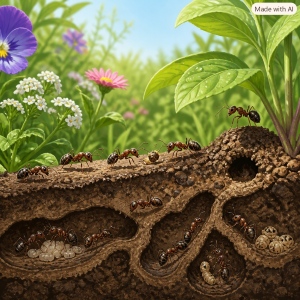
If you’ve recently noticed ants in your flower bed, ants in your garden soil, or even ants in your vegetable garden, you’re not alone. Gardeners often wonder, "Are ants harmful in the garden or flowerbed?" or "Do ants do more good or harm?"

The short answer: ants are not bad for your plants. They don’t eat roots, flowers, vegetables, or soil. But their appearance is meaningful—they’re indicators of conditions in your garden that deserve attention.

Ants show up because the environment suits their lifestyle. Understanding why they appear helps you decide whether to simply ignore them, manage the conditions attracting them, or take steps to reduce their numbers.
Are Ants in the Garden Good or Bad?

Are Ants in the Garden Good or Bad?

Ants in garden beds, borders, containers, compost piles, and even soil bags are neither good nor bad by themselves. They are:

So why do people often spot tiny ants in flowerbeds, black ants in the soil, red ants on lawns, or even flying ants among the flowers? It all comes down to the conditions ants require. Understanding the reason will help you make the right decision.

Why Ants Appear in Specific Garden Areas.

🌱 Ants in the flowerbed.

The flowerbed is swarming with ants, and the gardener is worried they might cause damage. Let’s find out why the ants have appeared there.

Ants gather in flower beds because:
Their presence usually means the bed has ideal nesting conditions or pest activity, not plant damage.

🥕 Ants in Vegetable Gardens.

Here is why ants have appeared in the lettuce and carrot beds.

Vegetable patches attract ants when:
Ants’ diet consists of protein (for the larvae) and sugar (for the adults). They do not need vegetables. Ants don’t harm vegetables—they’re responding to food sources or soil conditions.

🍎 Ants in Fruit Orchards.

Are red ants in the garden good or bad? Fruit trees draw ants because of:

This often signals cleanup needs, not plant danger.

🌼 Ants in Garden Pots, Containers, and Soil Bags.

The reasons are the same: warmth, shelter, and a nearby food source. Look for a source of food for the ants nearby. This is a sign the plant may need watering adjustments or repotting.

🌿 Ants in Herb Gardens.

Herb gardens attract ants for the same reasons as flower beds: nectar, soft soil, and shelter.

🍃 Ants in Garden Lawns and Borders.

Garden beds, lawns, orchards, and flowerbeds attract ants with cozy nesting spots and a nearby supply of tasty food.

"What about aphids? Everyone knows that ants herd aphids."

Indeed, ants and aphids live in symbiosis. Aphids secrete a tasty honeydew, while ants protect them from predators. An important detail: ants do not farm aphids the way humans do. They simply take advantage of the fact that an aphid queen has laid eggs on a branch near their nest. A gathering of conspicuous black ants can alert you to the problem before the aphids spread throughout the entire garden. Ants do not transplant aphids to new locations; instead, they herd them into a single spot. Sometimes you might see an ant carrying an aphid somewhere. The answer is simple: it is a dead insect, so it will serve as food for the larvae. The voracious growing generation needs protein to develop. Caterpillars, beetles, and worms—most garden pests end up as food for the ants.

There is one type that is particularly troublesome for homeowners: carpenter ants.

It is said that in the silence, you can even hear them gnawing on the wood as they slowly but surely devour the house. Is this true?

Yes and no. Carpenter ant mandibles are not strong enough to chew through solid wood. They are not termites and do not feed on cellulose. They only chew galleries into wood that’s already damp, softened, or decayed, using it as convenient nesting space rather than a food source. Their presence is a warning sign that moisture and rot are present long before the problem becomes obvious to a homeowner. At the same time, they aren’t entirely bad actors: as they remove the decayed material, they also clean and disinfect the surrounding surfaces with formic acid, helping maintain a stable, hygienic environment for their colony.

Ants as Indicators, Not Pests.

Wherever they appear in the garden—be it flowerbeds, raised beds, compost piles, flowerpots, or vegetable patch — they can cause inconvenience (for example, when transplanting plants). The nuisance factor—not plant damage—is usually what motivates homeowners to act.

Managing Ants in Flower Beds and Garden Beds.

You have two valid paths:
1. Address the Conditions Attracting Ants. When conditions change, ants often relocate on their own.
2. Reduce Ant Activity. Reduce the ant population using special products.
Both approaches are valid. The choice depends on your comfort level and garden style.

Ants are indicators of conditions in your garden—not a threat to your plants. You decide whether to leave them, manage the conditions attracting them, or reduce their numbers for comfort.

0 0 votes
Article Rating
Subscribe
Notify of
guest

0 Comments
Oldest
Newest Most Voted
Translate »
0
Would love your thoughts, please comment.x
()
x